



MS. Sujata Chatterjee.
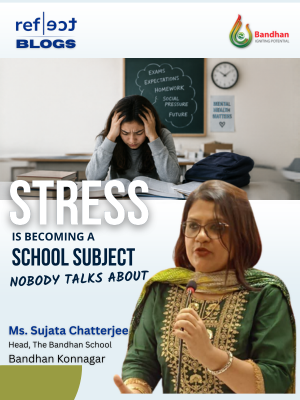
The Growing Reality of Stress in Education
A few years ago, stress in school life was mostly associated with board examinations, annual results, or competitive entrance tests. Today, the situation looks very different. Stress has quietly moved beyond examination halls and entered everyday student life.
It now exists in classrooms, homework schedules, tuition routines, activity calendars, performance expectations, and even casual conversations between children. Many students are learning how to handle pressure long before they learn how to understand their own emotions.
That should concern all of us.
The modern education system has undoubtedly become more competitive. Expectations around academic performance, extracurricular participation, communication skills, and future preparedness have increased significantly. While ambition and discipline are important, the growing pressure on children is creating an emotional environment that often goes unnoticed.
In many schools today, students are not just studying. They are constantly performing.
When Learning Starts Feeling Like Performance
One of the clearest signs of stress in education is the way students now approach learning itself.
We often hear questions like:
- “Will this come in the exam?”
- “How many marks is this chapter carrying?”
- “Is this important for boards?”
Far less frequently do we hear:
- “Why does this happen?”
- “How does this actually work?”
- “Can we explore this further?”
This shift matters.
It reveals how deeply academic pressure has shaped the student mindset. Learning is slowly becoming transactional. Effort is increasingly connected to marks, ranks, percentages, and external validation rather than curiosity or meaningful understanding.
Somewhere along the way, children started believing that their value rises and falls with performance. And that belief creates emotional strain far earlier than most adults realise.
The Silent Pressure Students Carry Every Day
Student stress is not always dramatic or visible.
Some children continue scoring well while silently struggling with anxiety, exhaustion, self-doubt, or fear of disappointing parents and teachers. High-performing students are often among the most emotionally burdened because they feel constant pressure to maintain expectations. Achievement can become emotionally exhausting when children believe they are only appreciated when they succeed.
The pressure becomes even heavier because modern students rarely get true downtime. School hours are followed by tuition classes, assignments, projects, competitive preparation, activities, and screen-heavy schedules. Even weekends often become extensions of academic planning.
A timetable filled with achievement can still leave very little room for childhood. And childhood is not something children should have to earn.
How Comparison Culture Is Increasing Student Anxiety
Another major contributor to stress among students is the comparison culture.
Children today grow up in environments where achievements are constantly visible and constantly measured. Marks, medals, ranks, admissions, competitions, certificates, and accomplishments are openly discussed both offline and online. Social media has intensified this pressure further.
Students are no longer comparing themselves only with classmates. They are comparing themselves with curated versions of success everywhere around them. Someone always appears smarter. More talented. More accomplished. More productive. Over time, comparison stops motivating children and starts quietly damaging self-worth.
Many students begin feeling that no matter how much they achieve, it is never enough.
The Emotional Signs Adults Often Miss
One of the biggest challenges surrounding mental health in schools is that stress does not always look obvious. A stressed child may not always express emotions directly. Instead, the signs often appear through behaviour:
- Irritability
- Withdrawal
- Fear of failure
- Perfectionism
- Difficulty sleeping
- Emotional shutdown before exams
- Loss of confidence
- Hesitation to participate in class
Sometimes children become unusually quiet after making one mistake in front of their peers. Sometimes they stop asking questions because they fear sounding wrong. Sometimes they become emotionally dependent on marks for validation. Children may not always have the vocabulary to explain emotional overwhelm clearly. But their behaviour often communicates it.
Why Emotional Safety Matters in Schools
A healthy learning environment is not one without discipline or expectations. Structure and accountability are essential parts of education. However, there is an important difference between healthy encouragement and constant pressure.
One builds confidence. The other slowly erodes it.
Students learn best when they feel emotionally safe enough to ask questions, make mistakes, think independently, and participate without fear of humiliation. Fear may improve short-term academic performance, but it rarely develops emotionally secure learners. Curiosity struggles to survive inside continuous anxiety.
This is why emotional well-being in education can no longer remain a secondary conversation. Schools must actively create spaces where students feel heard, respected, and supported, alongside being academically challenged. Because education is not only about producing high scorers. It is also about developing emotionally resilient human beings.
The Role of Parents and Educators
Parents and educators together shape how children experience success, failure, and self-worth.
When conversations revolve only around marks, rankings, or comparisons, children slowly begin associating love, approval, and confidence with achievement alone. Over time, this creates unhealthy emotional dependency on performance. Children need encouragement, but they also need reassurance.
They need to know that:
- Mistakes are part of growth
- One examination does not define intelligence
- Failure is not personal inadequacy
- Rest is not laziness
- Learning is bigger than marksheets
Teachers also play a powerful role here. A classroom where students feel comfortable expressing doubt, asking questions, and exploring ideas without embarrassment often becomes a far healthier learning space than one driven entirely by fear-based perfection. The richest classrooms are not always the quietest ones.
Sometimes they are the ones filled with curiosity, discussion, experimentation, and thoughtful mistakes.
Rethinking Success in Modern Education
Perhaps the most important question we need to ask ourselves today is this: Are children truly learning, or are they simply becoming experts at handling pressure?
Academic excellence matters. Discipline matters. Hard work matters. But emotional well-being matters too.
A successful education system cannot be built solely on achievement while ignoring the emotional toll students quietly carry every day. Schools must prepare children for life, not emotionally exhaust them before life has properly begun. Because years later, students may forget a chapter, a formula, or even an examination score.
But they rarely forget how education made them feel while growing up.