The Bandhan Climate Action Programme is not just an environmental project; it is a movement to reimagine how communities interact with their natural surroundings. It recognises that the challenges of climate change are not uniform; they differ between dryland zones plagued by droughts and infertile soils, and coastal belts threatened by rising sea levels and cyclones. BCAP responds to these unique realities with tailor-made interventions that combine scientific innovation with community participation. From training farmers in climate-smart agriculture to regenerating mangrove forests and introducing renewable energy in irrigation, the programme takes a holistic view of climate resilience. It is a bridge that connects policy-level frameworks on climate action with practical, ground-level solutions that transform lives. Bandhan-Konnagar launched the Bandhan Climate Action Programme (BCAP) in 2021. Since its inception, BCAP has been responding to the growing challenges of climate change, particularly in vulnerable dryland and coastal regions of India. The programme is designed to address the root causes of environmental degradation while strengthening the resilience of local communities. BCAP promotes a balanced relationship between people and nature by introducing sustainable agricultural practices, restoring fragile ecosystems, and ensuring reliable access to resources like water and energy. Unlike short-term relief measures, BCAP offers long-term, community-driven solutions that combine scientific knowledge with local wisdom. By doing so, it paves the way for healthier ecosystems, stronger livelihoods, and climate-ready communities capable of facing an uncertain future. Importantly, BCAP also collaborates with innovative carbon financing platforms, such as Explore Carbon Angel, to unlock opportunities for communities to benefit from carbon markets. Through this partnership, ecological restoration efforts, whether mangrove regeneration, watershed development, or renewable energy adoption, are translated into measurable carbon credits. These credits not only incentivise conservation but also generate financial returns for grassroots stakeholders, thereby creating a powerful cycle where environmental action fuels economic empowerment.
Vision and Mission
The vision of BCAP is to build a world where communities live in harmony with their environment, resilient to the impacts of climate change, and secure in both livelihood and ecology. It imagines landscapes where dryland farmers can cultivate sustainably despite droughts, coastal families can thrive while protecting mangrove forests, and renewable energy powers farming without harming the planet.
The Mission is to transform vulnerable communities into agents of climate action. BCAP works to reduce the risks posed by extreme weather, promote sustainable farming and resource use, restore vital ecosystems, and empower people, especially women and youth, to take charge of conservation. By linking local action to global goals such as the Sustainable Development Goals (SDGs 13, 14, and 15) and by leveraging platforms like Explore Carbon Angel to integrate carbon finance into community development, BCAP ensures that its efforts contribute to both immediate survival and long-term sustainability.
View Image Gallery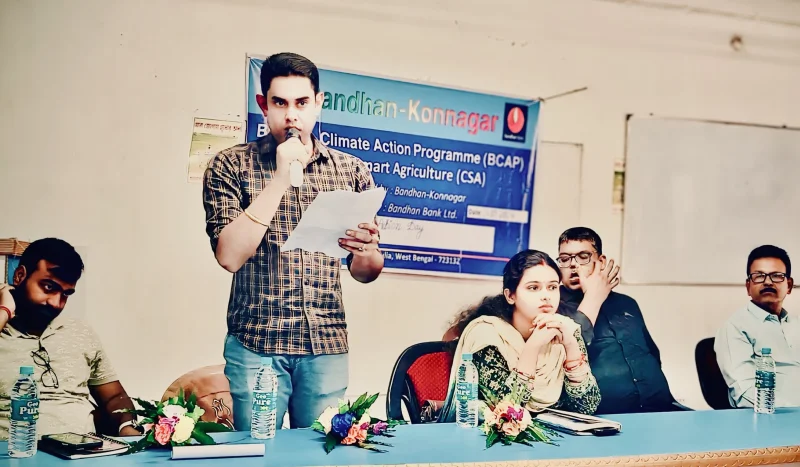
Objectives of BCAP
BCAP is structured around comprehensive objectives that aim to enhance community resilience and environmental sustainability:
How Bandhan Climate Action Programme Bridges the Gap
Climate change presents a dual challenge: while science offers solutions, these rarely reach the grassroots in a way that is accessible, affordable, and actionable. BCAP closes this gap by translating scientific innovations into everyday practices that can be adopted by small farmers, fishers, and rural families. It empowers communities to take ownership of their environment through Climate Action Groups (CAGs), Farmer Field School (FFS), and SHG, which serve both as custodians of local resources and as advocates for broader climate action.
This bridging role extends to livelihoods as well. Instead of choosing between environmental conservation and income security, BCAP designs interventions where both reinforce each other, for example, restoring mangroves while creating eco-friendly income opportunities, or introducing solar irrigation that reduces costs while cutting emissions. Through its collaboration with Explore Carbon Angel, these interventions are monetised in the form of carbon credits, further enhancing livelihood security while strengthening global climate mitigation efforts. By integrating knowledge, technology, and local participation, BCAP ensures that climate resilience is not imposed but co-created with the very communities it seeks to serve.
Key Interventions
BCAP operates through a set of carefully designed interventions that are both ecologically sensitive and economically inclusive, ensuring that communities thrive while ecosystems regenerate. Each intervention is deeply rooted in the principle of sustainability and tailored to local climatic contexts.
Climate-Smart Agriculture in Dryland Regions
The dryland zones of India are highly vulnerable to rising temperatures, erratic rainfall, and recurring droughts. BCAP’s approach to Climate-Smart Agriculture (CSA) transforms these fragile landscapes into hubs of resilience. Farmers are trained through Farmer Field Schools in soil health management, rainwater conservation, agroforestry and integrated farming systems. Instead of risky monocropping, they are encouraged to adopt multi-crop and drought-tolerant systems that stabilise yields. Organic farming, composting, and integrated pest management further restore soil vitality. Over time, previously fallow or degraded lands are revived, ensuring both food security and ecological renewal. Soil fertility degradation due to excessive chemical fertiliser use has led to declining crop yields and environmental concerns. BCAP encourages farmers to shift towards organic farming by promoting vermicomposting. Vermicompost, produced using earthworms to break down organic waste, enriches soil health, enhances microbial activity, and improves crop productivity. Farmers are provided with training and support to set up vermicompost pits, ensuring a steady supply of high-quality organic manure that enhances soil structure and fertility. Azolla, a fast-growing aquatic fern, is an excellent source of protein-rich fodder for livestock. BCAP has introduced the concept of Azolla pits to improve livestock nutrition and reduce dependency on commercial feed. Azolla cultivation requires minimal resources and grows rapidly, making it an ideal supplement for cattle, poultry, and fish farming. By incorporating Azolla into their feeding practices, farmers can enhance animal health, improve milk production, and lower feeding costs.
Integrated Watershed Development in Dryland Regions
Water is central to resilience in arid and semi-arid regions. BCAP promotes watershed-based planning that treats land, water, and vegetation as a single, interconnected system. Through rainwater harvesting, small-scale check dams, percolation tanks, and contour bunding, the programme ensures efficient water capture and storage. Restored watersheds not only provide irrigation security but also replenish groundwater, reduce erosion, and regenerate vegetation. This integrated approach creates landscapes where agriculture, ecology, and human needs are in balance.
Mangrove Restoration and Coastal Ecosystem Protection
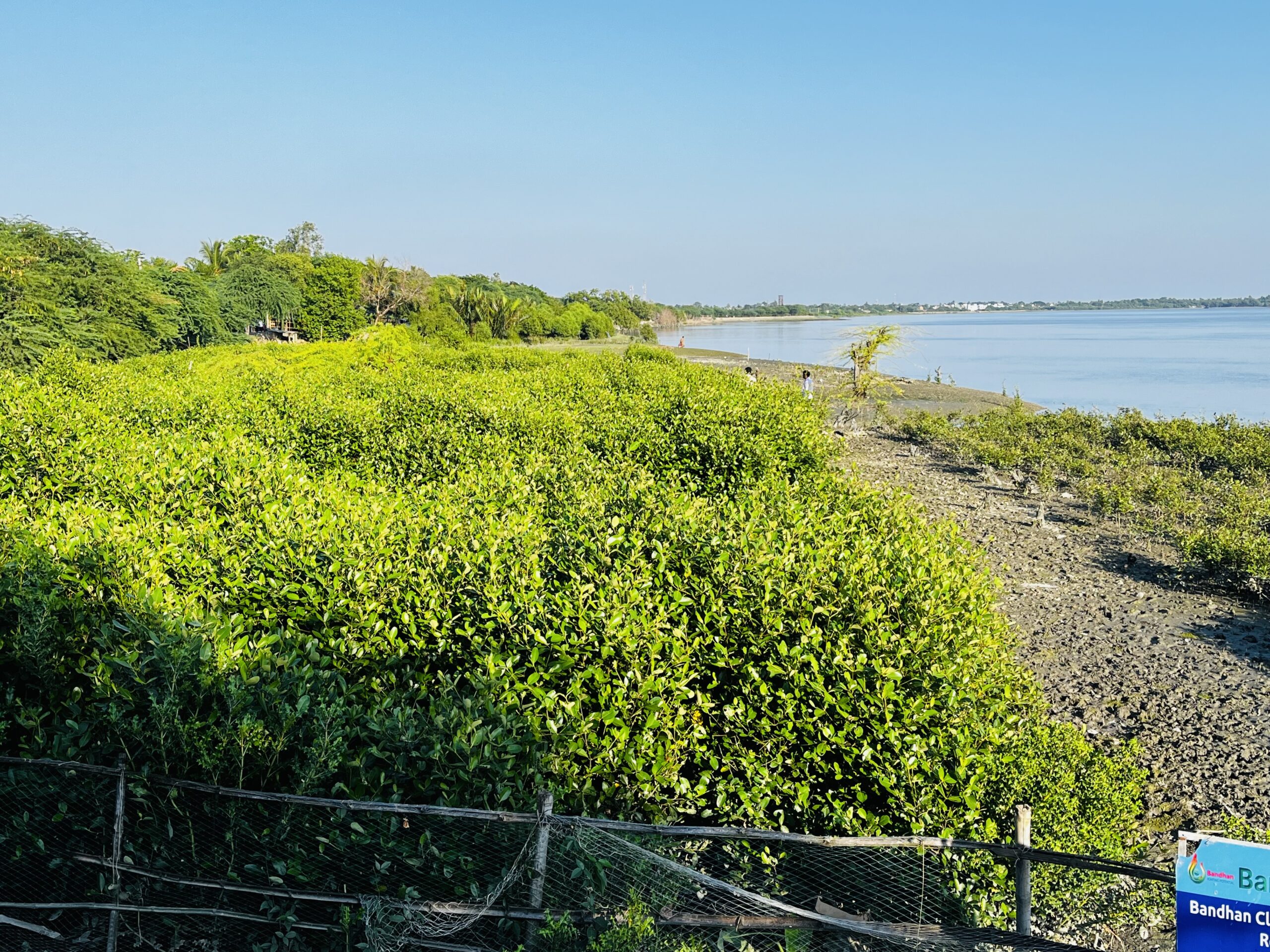
Along India’s fragile and storm-battered coasts, the Bandhan Climate Action Programme (BCAP) has emerged as both healer and protector, working tirelessly to restore degraded mangrove forests that are nature’s living fortresses against cyclones, tidal surges, and the creeping rise of seas. These mangroves, with their intricate roots spreading like woven shields, not only hold back the ocean’s fury but also anchor the lives of the communities that dwell along these vulnerable shores. Recognising this profound interdependence, BCAP does not simply plant trees; it nurtures the resilience of ecosystems and of people alike.
In the delicate mangrove belts of West Bengal’s riverine and coastal zones, BCAP has combined scientific discipline with the wisdom and participation of grassroots communities to regenerate landscapes at a scale and quality rarely achieved. Over 2,00,000 saplings have already taken firm root across 7.5 hectares of degraded land, with survival rates verified at 83%, a testament to the precision of species selection and care taken in planting. The diversity restored includes resilient and climate-adapted species such as Avicennia alba, Avicennia officinalis, Avicennia marina, Bruguiera gymnorhiza, Sonneratia apetala, Rhizophora apiculata, and Sonneratia griffithii, carefully chosen to revive ecological equilibrium and reweave the fabric of biodiversity that these wetlands once vibrantly held.
But the true beauty of BCAP’s endeavour is that ecological revival and human prosperity walk side by side. For the 150 households directly engaged and the 500 people indirectly uplifted, these mangrove initiatives have become more than protective barriers; they have become gateways to opportunity. Communities are empowered to raise nurseries, plant and maintain forests, and participate in income-generating activities like honey harvesting, crab fattening, cage aquaculture, and eco-tourism. Solar-powered irrigation systems and sustainable fisheries weave further resilience into daily lives, ensuring that the coast is not merely surviving storms but building a stronger future. Women and youth, once on the margins of economic activity, now lead efforts that tie conservation to the dignity of labour and the sustainability of income.
The programme’s approach, rooted in the Ecological Mangrove Restoration (EMR) model, is deeply site-specific and profoundly participatory. Instead of imposing a one-size-fits-all solution, BCAP ensures that each stretch of shore is matched with the species and management best suited for long-term survival. In doing so, conservation ceases to be a temporary intervention and becomes a living partnership between nature and people.
The impacts ripple widely: natural embankments fortified with green walls that absorb cyclone shocks; estuarine habitats reborn to shelter fish, crustaceans, and countless other species; landscapes transformed into buffers that absorb climate risks while sustaining livelihoods. What results is not merely restoration, but regeneration, of ecosystems, of hope, and of the cultural heritage of coastal stewardship.
BCAP’s story is thus not only about trees, tides, and science, but about people who, once vulnerable to the whims of the sea, now stand taller beside it. With every sapling planted and every livelihood renewed, the coastline becomes more than just a place of survival: it becomes a realm of resilience, where humanity and nature thrive as one.
Cage Cultivation and Sustainable Aquaculture
To reduce dependence on declining wild fisheries, BCAP introduces cage aquaculture systems in both inland and coastal waters. These systems enable communities to cultivate fish in controlled, environmentally sustainable ways, ensuring food security and steady income without overexploiting natural resources. By combining technical support with market linkages, BCAP provides fisher families with a stable and sustainable alternative livelihood, while also contributing to nutritional security.
Renewable Energy for Irrigation and Agriculture
Recognising the carbon footprint of agriculture, BCAP promotes the adoption of solar-powered irrigation systems and other renewable energy technologies. These systems replace diesel pumps, reduce input costs for farmers, and cut greenhouse gas emissions. Beyond irrigation, renewable energy is also applied to support small-scale agricultural enterprises, enabling climate-friendly farming that is both affordable and future-ready.
Together, these interventions strengthened by the carbon financing opportunities through the Exploration of Carbon Angel form the backbone of BCAP’s philosophy: building climate resilience through ecological restoration, technological innovation, and human empowerment. By integrating dryland and coastal strategies under one umbrella, BCAP sets a model for holistic climate action that is both locally grounded and globally relevant.